
Hail Damage vs. Normal Roof Wear: How to Tell the Difference
Is it storm damage or just an old roof?
That's the question almost every Grand Rapids homeowner is silently asking after a hailstorm rolls through the area and a contractor knocks on the door offering a "free inspection." The answer matters more than most homeowners realize. Mistake hail damage for normal wear, and you may walk away from a covered loss that your insurance would have paid for. Mistake normal wear for hail damage, and you may end up filing a claim that gets denied, or worse, signing up for a full roof replacement you didn't actually need.
The good news is that there is a real, reliable difference between hail damage and roof wear, once you know what you're looking at. The visual signatures, patterns, and contexts are distinct. This guide walks through how to tell them apart, where the confusion usually comes from, and what an honest roof assessment looks like when you want a straight answer.
The core difference: random and sudden vs. uniform and gradual
The single most important distinction between hail damage and normal roof wear is the pattern.
Hail damage is sudden, random in placement, and concentrated by direction.
A storm hits, and within a few minutes, a roof either takes hail or it doesn't. The impacts land more or less wherever hailstones happen to fall. They tend to be denser on the slopes facing the direction the storm came from, usually the west or southwest in Grand Rapids, and lighter on slopes that were sheltered. Within a damaged slope, the impacts are scattered, not clustered along walking paths or following any kind of orderly line.
Normal roof wear is gradual, uniform, and follows sun exposure.
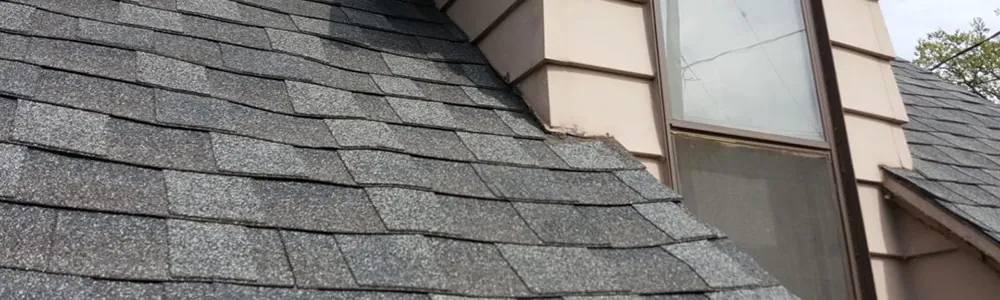
Aging on an asphalt shingle roof happens slowly over years and shows up evenly. South-facing slopes wear faster than north-facing ones because they absorb more UV. Granule loss thins across the slope rather than concentrating in spots. Shingles curl, lift at the edges, or develop a brittle texture. None of this happens overnight, and none of it looks like a storm hit yesterday.
If a roofer points to small dark spots on your roof and tells you it's hail damage, the first question is: are those spots scattered randomly with a clear concentration on a storm-facing slope, or are they spread evenly across the whole roof? If it's the latter, you're probably looking at aging, blistering, or foot traffic: not hail.
What normal roof wear actually looks like on asphalt shingles
Most roofs in Grand Rapids and the surrounding area are asphalt shingles. Here's what age looks like on that material, slope by slope and detail by detail.
Uniform granule loss.
Over the years, asphalt shingles slowly shed the colored granules that protect the asphalt mat from UV. This thinning happens across the whole shingle, not in spots. Older roofs may have a slightly faded, dusty appearance compared to fresh shingles, and gutters will accumulate a slow but steady amount of granule sediment over time. None of this is a sudden event.
Curling and cupping.
As shingles age, the edges or corners start to lift, curl up, or pull away from the underlying course. This usually happens first on the slopes with the most sun exposure. It is age, not impact.
Cracking that follows aging patterns.
Aged shingles can develop cracks, but these usually appear along the bottom edges, around nail lines, or in patterns related to flexibility loss, not in random circular spots.
Color fading and chalking.
Sun exposure dulls the color of asphalt shingles over the years. A roof that looks tired or sun-bleached compared to its original color is showing age.
Algae streaks.
Dark vertical streaks running down a shingle from the top edge are usually algae growth, especially in humid conditions or on north-facing slopes. This is cosmetic and unrelated to storms.
Loose or missing tabs from age, not wind.
As adhesive seal strips age, shingles can loosen. This is gradual and tends to be widespread or concentrated on the windward edges of the roof, not random across slopes.
None of these conditions, on their own, indicate hail damage. They indicate a roof that has been doing its job for years and is showing the wear of time.
What hail damage looks like by contrast
A roof with real hail damage looks different in several specific ways. The signs to look for are concentrated on the slopes that faced the storm and are absent or much lighter on sheltered slopes.
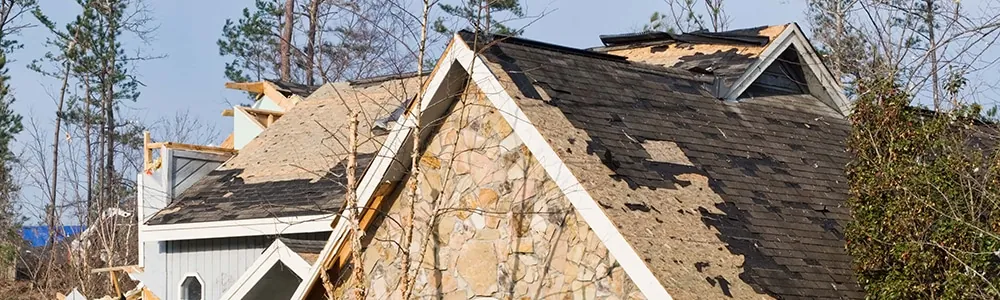
Round, dark impact marks where granules have been knocked free, exposing the black asphalt mat underneath. The marks are usually about the size of a dime or quarter and scattered randomly across the slope. Bruising or soft spots in the shingle mat, often invisible from above but detectable by pressing on the surface. Fresh granule accumulation in gutters and downspouts following a specific storm event, rather than a slow buildup over years. Damaged or dented flashing, dimpled siding, and dented gutters confirm the storm hit hard enough to deform metal. Dents on AC condenser fins, garage doors, mailboxes, and vehicles that face the storm direction.
The pattern is the giveaway. Damage that concentrates on one or two slopes and corresponds to ground-level signs of impact, such as dented gutters or hail on metal items, is real hail damage. Damage that looks the same on every slope of the roof, regardless of which direction it faces, is almost always wear or another non-storm condition.
When a roof is both old and storm-damaged
This is where it gets interesting, because the most common honest scenario isn't "it's hail" or "it's wear": it's both.
An older roof can absolutely be damaged by hail, and the damage is often more serious because aged shingles are less flexible and more prone to cracking under impact. An honest assessment in this case doesn't pretend the roof was new when the storm hit. It tells you two true things at the same time: this roof was already nearing the end of its service life, and this storm accelerated that timeline significantly.
That's a legitimate scenario for an insurance claim, depending on policy type. Some homeowner policies cover roof damage at full replacement cost regardless of age. Others cover only the depreciated cash value of an older roof. The conversation with your insurer about which applies should happen based on a documented inspection report, not based on assumptions about whether your roof was "too old to claim."
What a homeowner shouldn't accept is either of the two dishonest extremes: a contractor who says everything they see is hail damage and pushes for a full replacement claim, or one who says everything is just wear and there's nothing worth documenting. The truth, on most older roofs after a real hail event, is somewhere in the middle.
The lookalikes that get confused for hail damage
A few specific conditions get confused for hail damage all the time, both by homeowners and by contractors who either don't know better or are choosing not to know.
Blistering.
Asphalt shingles can develop small, raised blisters as part of normal aging, especially in hot conditions or with poor attic ventilation. When those blisters pop, they leave behind small round craters that look strikingly similar to hail impacts. The tell: blistering is spread uniformly across the entire roof regardless of slope direction. Hail damage concentrates on storm-facing slopes.
Foot traffic.
Anyone who has walked on a roof — chimney sweep, satellite installer, HVAC technician, prior roofer — can leave a path of granule loss and scuffing. This shows up as a visible route between an access point and a roof feature like a chimney or vent. Hail does not walk in straight lines.
Manufacturing defects.
Occasionally, individual shingles or batches come from the factory with thin coverage or other imperfections. These usually appear on a small number of shingles in a non-random pattern — often along a single course that was installed together.
Mechanical damage.
Tree branches, falling objects, animal traffic, and ladders can all leave damage that looks impact-related but has a different signature: a curved scratch, a torn edge, a clear scrape, rather than the scattered round hits of true hail.
A roofer who lumps any of these into "hail damage" without distinguishing them is either careless or selling. Either way, get a second opinion.
Why this question matters more after a Grand Rapids storm
The hail vs. wear question becomes especially loaded in the days after a real storm because that's exactly when out-of-area contractors, sometimes called storm chasers, show up in neighborhoods knocking on doors. Some are legitimate. Many are not. The dishonest ones have a financial incentive to label as much wear as possible as hail damage, push for an insurance claim, collect from the insurer, and either do poor work, do less work than was paid for, or disappear after collecting a deposit.
Conversely, some homeowners get convinced by a quick driveway visual that "the roof looks fine" and skip an inspection that would have revealed real damage worth claiming.
The fix is the same in both directions: a thorough, documented inspection by a local roofer with a real business address, a real history in West Michigan, and a willingness to put their findings in writing with photographs. That report, not a contractor's pitch in your driveway, is what tells you whether your roof has hail damage, normal wear, or both.
What an honest roof assessment includes
A trustworthy hail-versus-wear assessment in Grand Rapids has a few specific characteristics.
It distinguishes between the two in writing. The inspection report should clearly call out which conditions are storm-related and which are age-related, with photos for each. If the report says "hail damage observed" without separating that from existing wear, it's not specific enough to support a claim or guide a decision.
It identifies slope direction and pattern. The report should note which slopes face which direction and whether observed damage is consistent with a specific storm path. A roofer who has done this kind of work in Michigan can tie what they're seeing on your roof to weather events in the area.
It's honest about scope. Some roofs after a hailstorm have widespread, claim-worthy damage. Some have a small amount of cosmetic granule loss that doesn't change the roof's performance. Some have nothing more than the wear they had before the storm. An honest assessment tells you which of those situations you're in, even if it's the one where you don't have a claim.
It doesn't pressure you. A good local roofer is comfortable walking off a job after an inspection with no commitment from the homeowner. They are not in a hurry to get you to sign anything. If you feel like a contractor is rushing you to file a claim or sign a contract before you've had time to process what they showed you, slow down. That pressure is not in your interest.
Get an honest roof assessment
Above Roofing provides free, documented storm damage inspections across Grand Rapids and the surrounding West Michigan communities, including Wyoming, Kentwood, Grandville, Walker, Rockford, Ada, Cascade, Belmont, Comstock Park, and Sparta. Each inspection produces a written report with photos that clearly separates storm-related damage from normal roof wear.
There is no obligation, no pressure, and no contract until you have a clear picture of what your roof actually needs. If the answer is "your roof is mostly fine, here are a few things we noticed," that's the answer we'll give you. If it's "this storm caused real damage worth documenting for a claim," that's what we'll say, with the evidence to back it up.
For more on inspections, claims documentation, and storm response, visit our Storm and Hail Damage Roof Repair page.
Frequently asked questions
How do I tell hail damage from normal roof wear?
Hail damage is sudden, randomly scattered, and concentrated on slopes that faced the storm. Normal roof wear is gradual, uniform across slopes, and follows sun exposure. If what you're seeing is the same on every slope regardless of direction, it's almost always wear, not hail.
Can an old roof still be damaged by hail?
Yes, and often more severely than a newer one. Older shingles are less flexible and more prone to cracking under impact. An honest inspection will distinguish what was already there from what the storm added.
Will insurance cover hail damage on an older roof?
Depending on your policy. Some policies cover roof damage at full replacement cost regardless of age, others at depreciated cash value. The conversation should happen with your insurer based on a documented inspection report. Avoid assumptions in either direction.
What is blistering on a roof and how is it different from hail damage?
Blistering is a natural aging condition where small raised bubbles form on asphalt shingles. When they pop, they leave round craters that look similar to hail impacts. The difference: blistering is spread evenly across the roof. Hail damage concentrates on storm-facing slopes.
Why do contractors disagree about whether my roof has hail damage?
Some assessments are honest; some are pushy in one direction or the other. Storm chasers may label wear as damage to drive claims. Less thorough contractors may miss real damage entirely. The fix is a documented inspection with written findings and photos from a local roofer with verifiable history.
Should I get a second opinion if I'm not sure?
If you've gotten one assessment and something feels off, like the pressure to sign, vague descriptions, no photos, contradictions with what you can see from the ground, a second opinion is worth it. Reputable roofers expect homeowners to compare. Disreputable ones discourage it.
Related articles
Grand Rapids Storm Damage Checklist for Homeowners

Best Roofer for Storm Damage Insurance Claims in Grand Rapids
What to Photograph Before Filing a Roof Insurance Claim